Pinco – A Structural Review of Platform Economics and Risk Management
In the contemporary digital landscape, platforms like Pinco represent a complex intersection of consumer technology, behavioral economics, and financial risk management. This analysis provides a structured, risk-aware examination of the Pinco ecosystem, assessing its operational framework from an economic perspective. The platform’s sustainability hinges on its user interface efficiency, transactional integrity, and long-term value proposition. For a direct point of access, the operational portal is https://pinco-giris-az.com/. This overview will dissect these components, focusing on the systemic architecture rather than ephemeral promotions, to furnish a clear-eyed evaluation of the platform’s holistic offering.
Platform Architecture and Economic Interface Design
The Pinco interface functions as the primary market clearinghouse for user activity. Its design philosophy appears oriented toward minimizing transactional friction-a critical factor in digital platform economics. Navigation follows a logic that prioritizes liquidity of access to core functions: event markets, account management, and financial conduits. From a risk-management standpoint, the clarity of information presentation is paramount. Pinco’s layout generally segregates speculative activities from administrative functions, reducing cognitive load and potential for user error-a subtle but significant contributor to sustainable engagement. The visual hierarchy and load times are non-monetary costs; their optimization directly impacts user retention and platform efficiency.
Pinco Mobile Application – Portability and Capital Fluidity
The Pinco mobile application extends the platform’s market reach, effectively decentralizing access points. Its economic value lies in capturing user attention during non-stationary periods, thus increasing potential engagement windows. The app’s performance is a direct correlate to operational risk; latency or instability can erode user trust and perceived reliability of the entire financial pipeline. The application must maintain parity with the desktop platform in security protocols and transactional capability to prevent arbitrage opportunities for errors or fraud. Its design should facilitate, not complicate, the user’s ability to monitor exposure and execute decisions with full awareness of context.

The Registration Protocol – Onboarding as a Systemic Investment
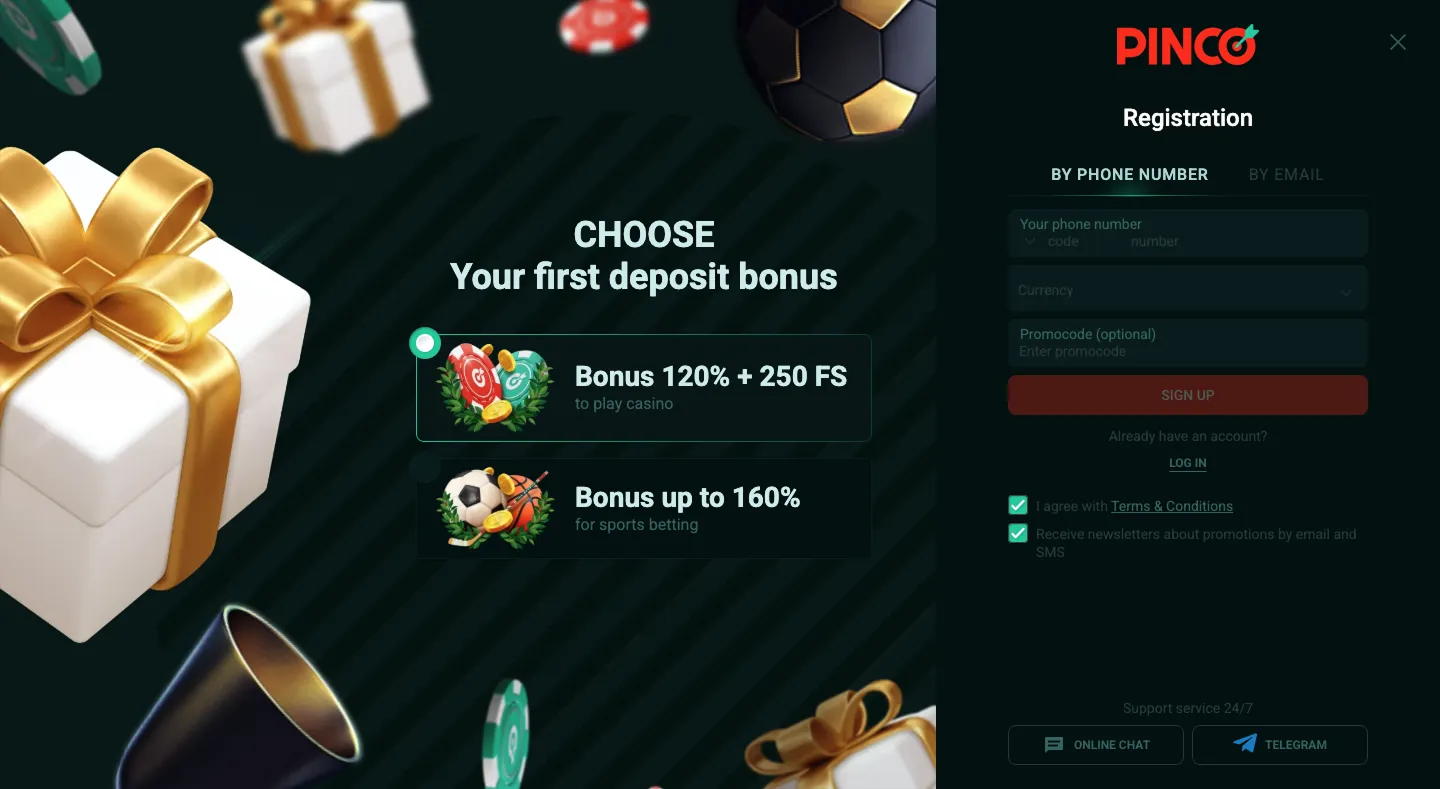
Registering with Pinco constitutes the user’s initial capital investment of personal data and time. The process is a contractual gateway, establishing the foundational legal and economic relationship. A streamlined, transparent registration minimizes initial barrier costs, but its simplicity must not compromise the subsequent security infrastructure. Pinco’s procedure requires standard identifiers, acting as the first layer in a multi-tiered risk-assessment model. The efficiency of this step is a leading indicator of the platform’s operational competence; excessive complexity suggests poor design, while undue brevity may foreshadow inadequate verification processes. The user’s long-term financial interaction with the platform is predicated on the integrity established at this juncture.
- Data Input Requirements: Analysis of necessary personal and contact information, framed as the initial deposit of reputational collateral.
- Verification Timelines: The period between account creation and activation represents a sunk cost for the user; its duration impacts initial platform valuation.
- First-Party Authentication: The creation of login credentials establishes the primary security asset, the compromise of which represents total systemic failure for the individual.
- Regulatory Acknowledgment: The mandatory acceptance of terms and conditions is the contractual underpinning, defining liability and recourse-a critical, often underweighted, component of risk.
- Geographic Compliance: The platform’s adaptation to local Azerbaijani market norms, including Manat-denominated accounting, is a non-negotiable for sustainable operation.
Financial Conduits – Deposit and Withdrawal Mechanics
The movement of capital is the central artery of the Pinco platform. Deposit mechanisms represent inbound liquidity for the user and a liability for the platform. The variety of channels-bank cards, e-wallets, possibly local Azerbaijani solutions-indicates market penetration and partnership stability. Transaction finality speed is a key performance indicator; however, instant deposits carry different risk weights compared to instant withdrawals. The latter is a stringent test of platform liquidity management. Pinco’s policies on transaction limits, processing times, and any associated fees constitute the explicit financial terms of engagement. These terms must be analyzed not as isolated features but as part of the platform’s overall cash-flow management strategy and its implications for user financial planning.
| Financial Instrument | Economic Function | Typical Risk Consideration | User-Centric Metric |
|---|---|---|---|
| Credit/Debit Card | Direct fiat currency ingress | Chargeback risk, intermediary fees | Processing time, acceptance rate |
| Electronic Wallet | Buffered value transfer | Counterparty risk on the wallet provider | Transfer synchronization, identity verification layers |
| Bank Transfer | High-value, non-immediate settlement | Operational lag, transparency of intermediary banks | Clear beneficiary details, tracking capability |
| Potential Local Payment Rails | Adaptation to Azerbaijani financial infrastructure | Regulatory compliance volatility | Familiarity, domestic customer support |
| Withdrawal Pipeline | Capital egress and profit realization | Most critical test of platform solvency and operational honesty | Time-to-wallet, clarity of pending status, fee structure |
Promotional Economics – Analyzing Pinco Bonus Structures
Bonuses and promotions are not mere gifts; they are strategic economic instruments designed to alter user behavior. They represent a liability on the platform’s balance sheet, offset by anticipated future activity. A risk-aware analysis of Pinco’s promotional landscape must scrutinize the attached wagering requirements, game restrictions, and time constraints. These factors convert the nominal bonus value into an effective value, which is often substantially lower. The economic purpose is to increase user stake and engagement duration, thereby generating the statistical certainty of retained revenue. Transparency in these terms is a direct proxy for the platform’s long-term alignment with user interests. Opaque or excessively restrictive conditions signal a short-term extraction model rather than a sustainable partnership.
- Welcome Incentives: The upfront cost of customer acquisition, to be evaluated against the lifetime value of the user.
- Rollover Requirements: The mechanism that ties the bonus capital to platform activity, effectively creating a conditional liability.
- Game Weightings: Differential contribution rates across activities, a tool for managing the platform’s risk exposure from the promotion.
- Expiration Dynamics: The time-value decay of bonus funds, a critical variable in the user’s strategic use of the capital.
- Loyalty Program Architecture: A long-term incentive model aiming to reduce churn and increase user lifetime value through tiered benefits.
Security and KYC – The Regulatory Capital of Pinco
Know Your Customer (KYC) protocols are not merely regulatory hurdles; they are essential risk-mitigation infrastructure that protects both the platform and the ecosystem. For Pinco, rigorous KYC represents an investment in regulatory capital and systemic integrity. The process of document submission-passport, utility bill-verifies the source of funds and user identity, combating fraud, money laundering, and underage access. The economic cost of this process is borne in user time and platform administrative overhead, but the cost of omission is existential: regulatory sanction, reputational collapse, and financial instability. Pinco’s implementation must be robust yet efficient, with clear communication channels for verification status. This framework is the bedrock upon which trust, the platform’s most valuable intangible asset, is built.
Data Asset Management – Pinco’s Custodial Responsibilities
Beyond KYC, the platform’s ongoing custodianship of user data and financial details is a continuous liability. Encryption standards, data storage policies, and breach response protocols constitute the platform’s defensive capital expenditure. A failure here is a direct erosion of user equity. The economic impact of a security incident extends far beyond immediate financial loss, encompassing long-term brand depreciation and increased cost of future user acquisition. Pinco’s commitment to this area is non-negotiable for sustainable operation; its provisions should be explicitly stated and readily accessible, not buried in legalistic documentation.
Operational Support – The Human Capital Interface
Customer support is the platform’s shock absorber for operational friction and the primary channel for dispute resolution. Its efficiency directly impacts user attrition rates and perceived platform reliability. Pinco’s support architecture-live chat, email, possibly telephone-represents a significant line item in operational expenses. The economic analysis focuses on availability, response latency, and first-contact resolution rate. Support agents must be empowered with both technical knowledge and diplomatic skill to de-escalate conflicts, which are inherent in an environment involving financial gain and loss. The quality of this human capital interface is a leading indicator of management’s commitment to long-term platform health over short-term profit maximization.
- Channel Accessibility: The cost to the user in time and effort to initiate a support query across different mediums.
- Resolution Efficiency: The speed and effectiveness with which support tickets are closed, impacting user satisfaction and operational backlog.
- Agent Empowerment: The degree to which front-line support can authorize solutions, or must escalate, adding layers of delay and potential for miscommunication.
- Knowledge Consistency: The uniformity of information provided across agents and channels, reducing arbitrage in user experience.
- Crisis Management Capacity: The support system’s load-bearing capability during widespread platform issues, a stress test of its structural design.
Synthesizing the Pinco Value Proposition – A Risk-Adjusted View
A holistic evaluation of Pinco requires synthesizing its disparate components into a coherent assessment of long-term viability. The platform’s value proposition is not a single feature but the net sum of its interface efficiency, financial integrity, security posture, and support quality, adjusted for the inherent risks of its core activity. For the Azerbaijani user, localization-from Manat transactions to culturally attuned support-is a significant value adder. The platform that successfully aligns its economic incentives with transparent operations, manages its regulatory and security risks prudently, and invests in user experience as a form of relational capital is positioned for sustainability. The alternative is a cycle of short-term attraction and long-term attrition, an economically unstable model. Pinco’s structural choices, as analyzed herein, provide the framework for determining its place on that spectrum.